











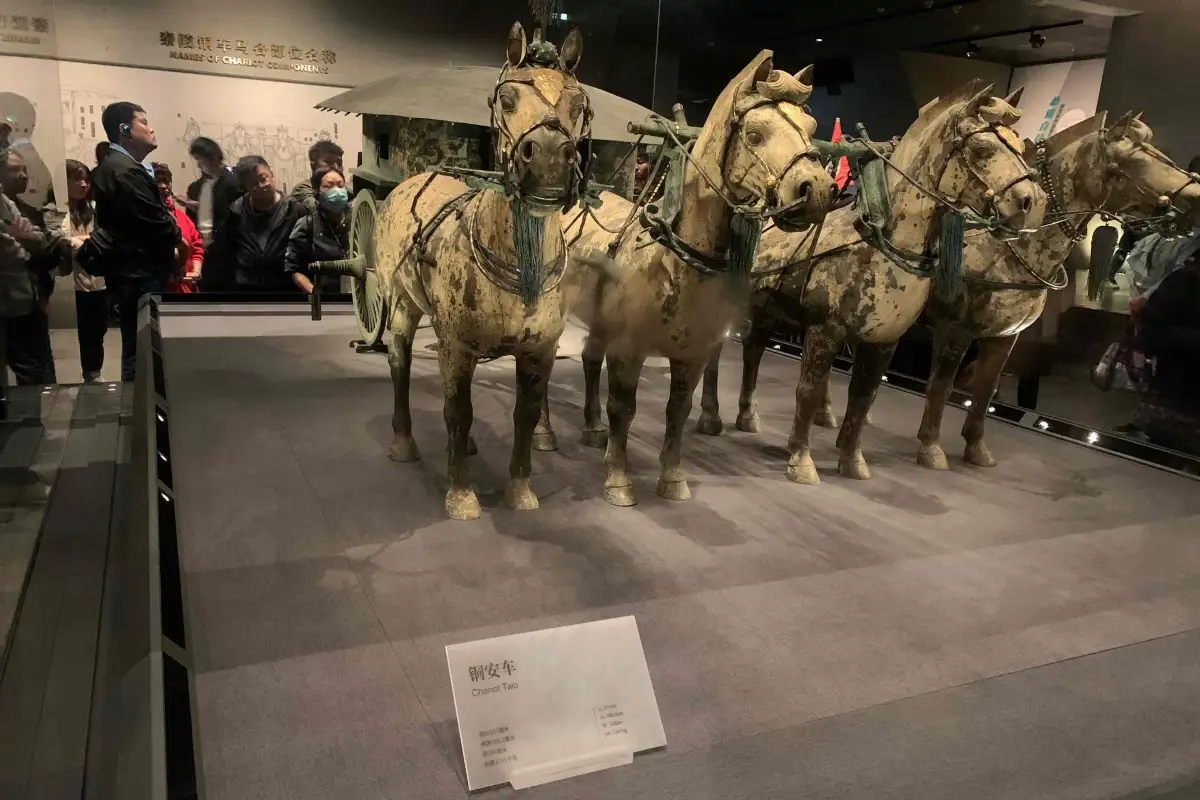
Every visitor asks the same question within five minutes of entering Pit One: “Were they always this color?” No — the army you photograph today is bare clay. When it left the workshops 2,200 years ago it was a riot of color: lacquer reds, malachite greens, azurite blues, bone whites, gilded details, and one pigment so advanced it is still studied in laboratories today — the synthetic “Púrpura chino”. This guide covers what the Terracotta Warriors originally looked like, why the color vanished so fast, and where you can still see traces of it.
Conclusiones clave
- The army was fully painted: lacquer base coat + mineral pigments over every figure.
- “Púrpura chino” — a synthetic barium-copper silicate — appears on the warriors; it has no natural source.
- The color died in minutes: on excavation, the lacquer ground dries, curls and flakes off, taking pigment with it.
- Conservation now fights back: freshly excavated zones are kept moist; some fragments of color survive on display.
- The replicas tell the story: color-reconstruction figures and displays show the army as it was buried.
See it in person: the pits open 08:30–19:00, tickets sold until 5:00 PM. Book from $18.03 on viaje.com and scan your passport at the gate.
The Qin palette
The warriors were finished in two layers. First, every figure got a coat of lacquer — tapped from lacquer trees, it dries to a hard, glossy film that seals the clay and gives paint something to grip. Over the lacquer went mineral pigments: cinnabar reds on robes and lacings, malachite greens and azurite blues on armor, bone and kaolin whites on under-layers, and gold leaf for the highest-status details. Faces were flesh-toned, eyes white with black pupils, hair black or dark brown. The result was not a toy-soldier uniformity — units were dressed in mixed colors, closer to a living army than a costume parade.
Chinese purple — a pigment ahead of its time
The most famous pigment on the army never existed in nature. Chinese purple (also called Han purple) is a barium-copper silicate — a lab product, manufactured at high temperature by specialists, centuries before chemistry as a science. It appears on Terracotta Warriors alongside the blues and greens, and its chemistry links it to synthetic Egyptian blue across two continents — a connection still debated in materials-science literature. When you hear that the army is “2,200 years ahead of its time,” this pigment is a literal example.
Why the color vanished in minutes
Here is the hard fact every guide should explain honestly: the paint was not stripped by the fire that burned the hangars, nor by 2,200 years of soil pressure alone — it was lost at the moment of discovery. The lacquer ground coat was buried wet for two millennia. Exposed to Xi’an’s dry air, the lacquer loses its water, shrinks, curls and flakes off in minutes — carrying the pigment layer with it. Early excavation photos show warriors with vivid patterns that today are bare clay. That is the loss the museum’s conservation teams now work against.
Where color still survives
- Freshly excavated zones: conservators keep new finds moist on site, and color-bearing fragments have been recovered from Pit One’s later excavation phases.
- Display fragments: museum cases hold pigment and lacquer fragments recovered from the pits — small, but genuinely 2,200 years old.
- Reconstruction displays: color-reconstruction figures and renders around the museum show the army as it looked when buried.
- The Kneeling Archer’s case: study him closely — traces and treatment work are part of his conservation story.
Knowing the army was painted changes how you see the pits. The bare clay you walk past is a skeleton; the color-reconstruction displays are the ghost; and the conservation lab is the fight to keep whatever color remains for the next generation of visitors.
Preguntas frecuentes
Why aren’t the warriors restored with paint?
Conservation policy treats the surviving fragments as evidence — repainting would destroy the original surfaces. The museum instead preserves what remains and shows the original appearance through reconstruction displays.
What was Chinese purple made from?
It is a barium-copper silicate manufactured at high temperature — a synthetic pigment with no natural source, used on the warriors alongside mineral colors like cinnabar and malachite.
Will new warriors come out with color?
Fragments and traces do survive on fresh finds when they are kept moist immediately — that is exactly why current excavation proceeds slowly and carefully, and why parts of Pit Two remain deliberately unexcavated.
Planifica tu visita
Meet the army before the color left
The reconstruction displays and conservation cases are included with every ticket — from $18.03 online, 3–5 hours for the full site.
Keep exploring: how the army was made, el caras historia, and the guía pozo por pozo for the visit itself.
Fuentes
- Museum conservation displays on lacquer, pigments and color reconstruction, observed on editorial visits.
- Published materials-science work on the warriors’ lacquer ground and synthetic Chinese purple (barium-copper silicate).
- Trip.com attraction listing (checked October 2026) and verified traveler reports.
