 01
นายพล
The tallest figures, in double-layered caps and fish-scale armor, hands clasped around the staff of command. Only a handful have been found — the pit roster stays realistic all the way to the top.
秦始皇兵马俑 · the buried army
An estimated 8,000 life-size soldiers were commissioned for the First Emperor's tomb; more than a thousand have been unearthed — and no two faces are the same. Meet the ranks, the craft and the weapons of the underground army.
An army made of clay
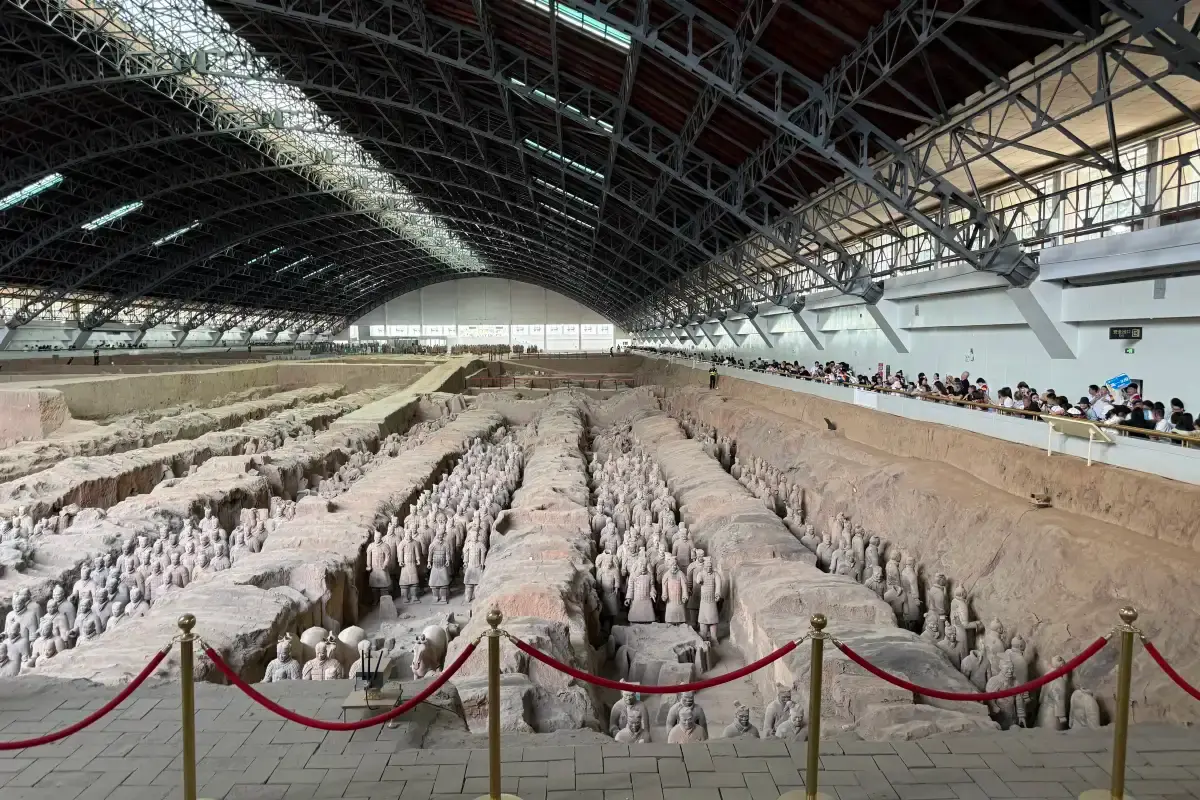
Ying Zheng ordered his tomb started at the age of 13, and it consumed nearly 720,000 workers over 38 years. Beside the unexcavated burial mound, his workshops raised an entire army out of the loess clay of Lintong: generals, infantry, archers, cavalry and chariots, ranked in battle formation facing east — toward the six warring states he had unified in 221 BC.
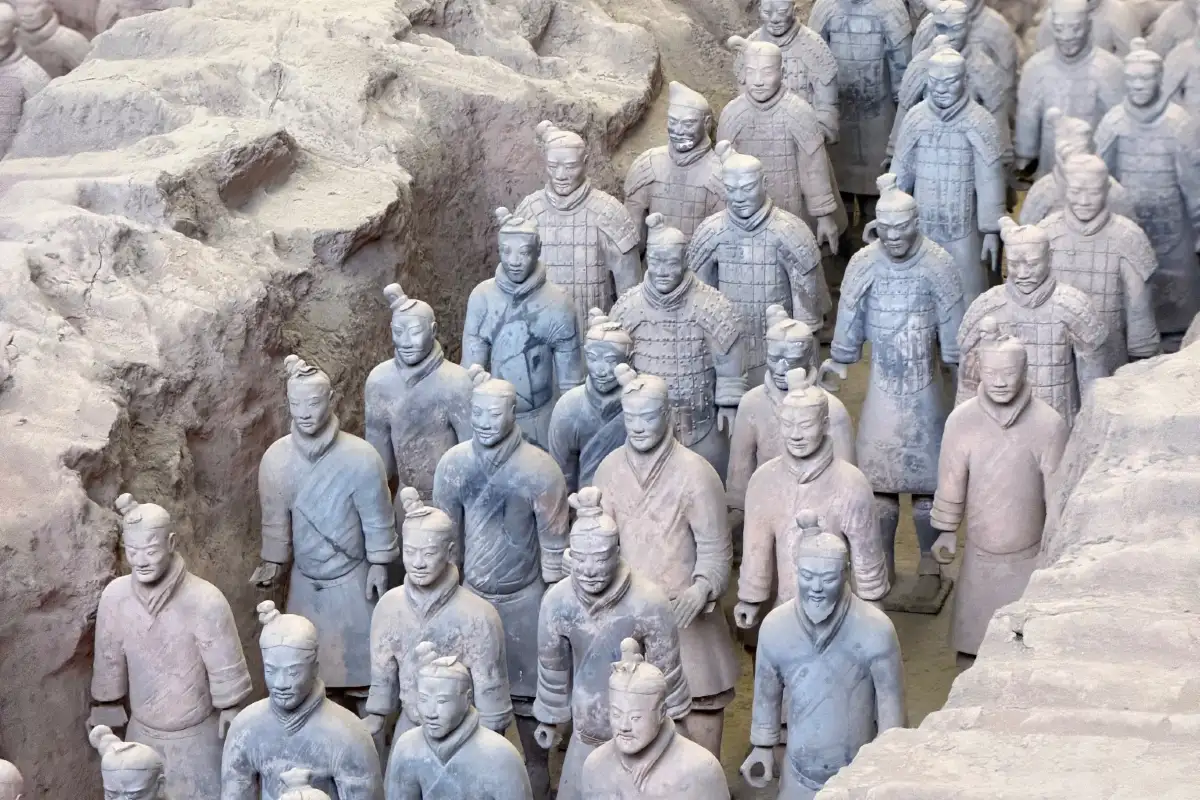
The army was discovered in March 1974, when farmers digging a water well east of the mound broke into a buried pit. What emerged is the greatest archaeological find of the 20th century: more than a thousand life-size terracotta warriors unearthed so far, each finished by hand, each with a face of his own. Standing before the front rank of Pit One, most visitors stop talking — exactly as the reviews promise.
Read the ranks
The army is a complete military roster in clay. Once you know the code — caps, armor, poses — you can read every soldier's rank and duty from across the hangar.
01The tallest figures, in double-layered caps and fish-scale armor, hands clasped around the staff of command. Only a handful have been found — the pit roster stays realistic all the way to the top.
02The backbone of the front rank: lamellar armor plates, shin guards, hair tied in topknots to the right. Their feet — square or pointed toes — hint at who stood the longest watches.
03Standing and kneeling crossbowmen kept the volley continuous. The Kneeling Archer — carved shoe treads and palm pads still crisp — is the army's most photographed figure.
 04
Saddle-mounted riders on short, solid horses; chariot crews with outstretched reins. The chariots themselves were real wood-and-bronze vehicles — only their metal fittings survive.
 05
Hundreds of life-size war horses with cropped manes and knotted tails, modeled on the stocky breeds of the Qin plains — and the half-size bronze teams in the Bronze Chariot Hall.
Faces & workshop
The army was mass-produced 2,200 years ago — yet personalized like portraiture. That paradox is the secret of the warriors.
Real metal, real army
The clay soldiers carry real bronze — tens of thousands of actual weapons buried with the army, many still sharp after 2,200 years underground.
Blades of cast bronze buried in the pits — some unearthed still gleaming and pliable enough to shave with, thanks to Qin metallurgy.
Interlocking bronze trigger mechanisms of uncanny precision — interchangeable parts, two millennia before "interchangeable parts" had a name.
Quadruple-pointed bronze arrowheads found in bundles — standardized to a degree that suggests assembly-line production.
Two half-size chariot-and-horse teams unearthed in 1980 — thousands of parts each, gold and silver inlay, "the Crown of Ancient Bronzes".
…and the uniforms: seven styles of armor across the ranks, belt hooks, topknots tied to regulation, and shoes with different soles for standing or kneeling duty. The army is a portrait of the Qin military system, not just its soldiers.
From clay to army
The whole force was manufactured beside the tomb — an assembly line 2,200 years ahead of its time.
Loess clay from Mount Li's foothills, pressed into bases, coiled into hollow torsos on solid legs.
Heads from eight molds, personalized by hand; hands shaped for their weapons; names stamped for quality control.
Fired near 1,000 °C, coated in lacquer, painted in reds, greens and Chinese purple.
Assembled into units, ranked in formation facing east, buried to guard the emperor forever.
Tickets from $18.03 — book online with Trip.com, scan your passport at the gate, and meet a thousand different faces in one morning.
 English English
 Chinese (China)
 Chinese (Hong Kong)
 Chinese (Taiwan)
 Russian
 Korean
 Japanese
 Thai
 German
 Spanish
 French
 Italian
 Portuguese