












Eight thousand soldiers, hundreds of horses, dozens of chariots — all made of clay, all fired, all ranked into a 38-year construction project beside the First Emperor’s tomb. How did a pre-industrial empire build an army of terracotta warriors at this scale, and why did they last? This guide follows the army from riverbank clay to buried formation: the loess quarries, the coiling technique, the modular workshop system, the kilns, the paint — and the quality-control stamps that made it all accountable.
重點
- Local loess clay was dug near Mount Li, pressed into bases and coiled into hollow torsos.
- Modular parts — heads, arms, hands, armor — were made separately, then joined before firing.
- Low-oxygen kilns fired the figures at roughly 950–1,050 °C near the tomb.
- Workshop stamps named the maker on many parts — traceable quality control from 220 BC.
- Then came the paint: lacquer base + mineral pigments, including the synthetic “Chinese purple”.
See the workshop story in the clay: the army stands in Lintong District, Xi’an — e-tickets from 攜程網 from $18.03, passport-scan entry, 08:30–19:00.
The clay under the army
The army begins with geology. The Lintong plain at the foot of Mount Li sits on deep, fine-grained loess — a clay-rich soil that is easy to dig, easy to model and, crucially, strong enough to survive firing. Workshops sat close to both the quarries and the tomb: you can trace the production zones around the necropolis, where workers dug clay, mixed it with quartz sand to control shrinkage, and pressed it into the thick rectangular bases every soldier still stands on.
Bodies: solid legs, coiled torsos
Each figure starts at the feet. Legs were built solid — sometimes solid enough that a single leg weighs as much as a whole modern statue — because they carry the load. From the waist up, the technique changes: torsos were built hollow by coiling ropes of clay up the body and smoothing them together, then paddled and scraped to final shape. Hollow upper bodies mean lighter loads, better firing, and room for the clay arms to be attached without cracking.
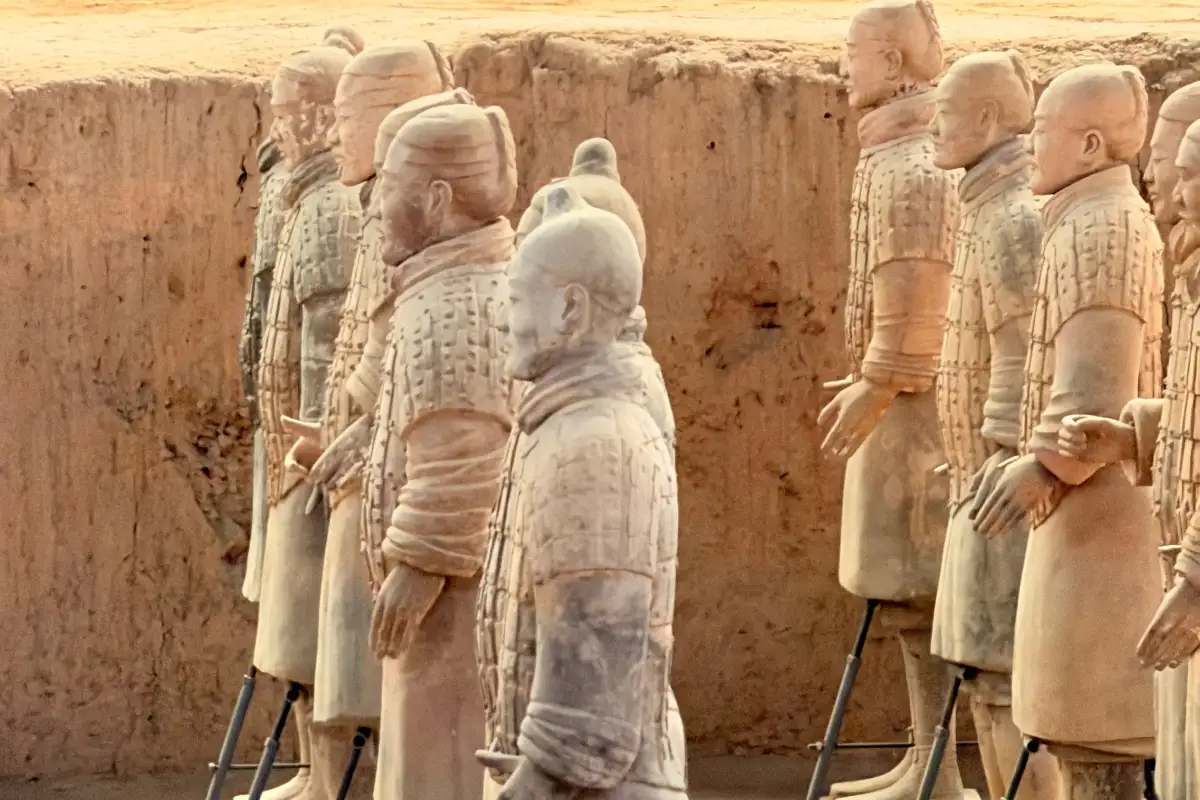
Look at any Pit One soldier with this in mind and the construction becomes visible: the seam lines, the paddled texture under the armor, the joints at the shoulder. The army is engineering you can see.
The kit of parts
Heads, hands, ears, arms and armor plates were manufactured separately — a kit of parts waiting for assembly. Heads came from a handful of standard molds and were then personalized by hand, which is exactly why no two faces are the same. Hands were modeled for their job: reins, bows, halberds, clasped staffs. Once assembled, the figure was finished with the details that make the pits unforgettable — lamellar armor rows, belt hooks, robe folds, shoe soles with carved tread patterns.
- Solid feet and legs carry the weight; hollow torsos survive the kiln.
- Heads from standard molds, then hand-finished — variety at production speed.
- Hands match duties: archer’s draw, charioteer’s reins, general’s staff.
- Workshop names stamped or carved onto parts — accountability built in.
Kilns and firing
The assembled figures went into earthen kilns near the necropolis, fired at an estimated 950–1,050 °C in reduced-oxygen conditions. That is the temperature window that turns loess clay into dense fired ceramic — tough enough for 2,200 years underground and, more remarkably, tough enough to have survived the roof collapse and fire that hit the pits after the Qin dynasty fell. Fired figures that cracked or warped were rejected: some mis-fired parts have been found, which is one more hint that this was a managed production line, not a one-off artistic commission.
Lacquer, pigments, assembly
After firing came color. Every figure was coated with a lacquer base, then painted with mineral pigments — cinnabar reds, malachite greens, azurite blues, bone whites, and the astonishing synthetic “Chinese purple”, a barium-copper silicate invented centuries before modern chemistry. Once painted and assembled into their units, the warriors were ranked into formation facing east, ready to guard the tomb the Emperor began building at 13.
Then the lacquer did what lacquer does when an underground chamber dries out: it curled and flaked within minutes of excavation, taking the color with it. What you see today is the army’s skeleton — see the original colors guide for what it once looked like.
常問問題
How long did it take to make one warrior?
No single figure has a documented build time, but the modular system was the whole point: parallel workshops producing parts at scale, finished and assembled by hand. The army took decades as a project, individual figures likely weeks.
Why are the warriors hollow?
Hollow torsos fire evenly and resist cracking; solid lower bodies carry the load. That split is the engineering trick behind an 8,000-figure army of fired clay.
Are the workshops still being excavated?
Excavation and restoration continue across the necropolis — the visible restoration lab in Pit One is part of the standard visit.
Plan your visit
See the production line in the pits
Once you know how the army was made, every hangar reads differently — seams, stamps, joints and restoration lab all become visible. Tickets from $18.03.
Continue the deep dive: the pit-by-pit guide, the Kneeling Archer profile, and the full roster in 勇士隊.
Sources & official references
- Museum displays on workshop organization, kiln technology and restoration (Pit One lab), observed on editorial visits.
- Standard archaeological literature on the army’s modular production and firing temperatures.
- Trip.com attraction listing and verified traveler reports (2025–2026).
